
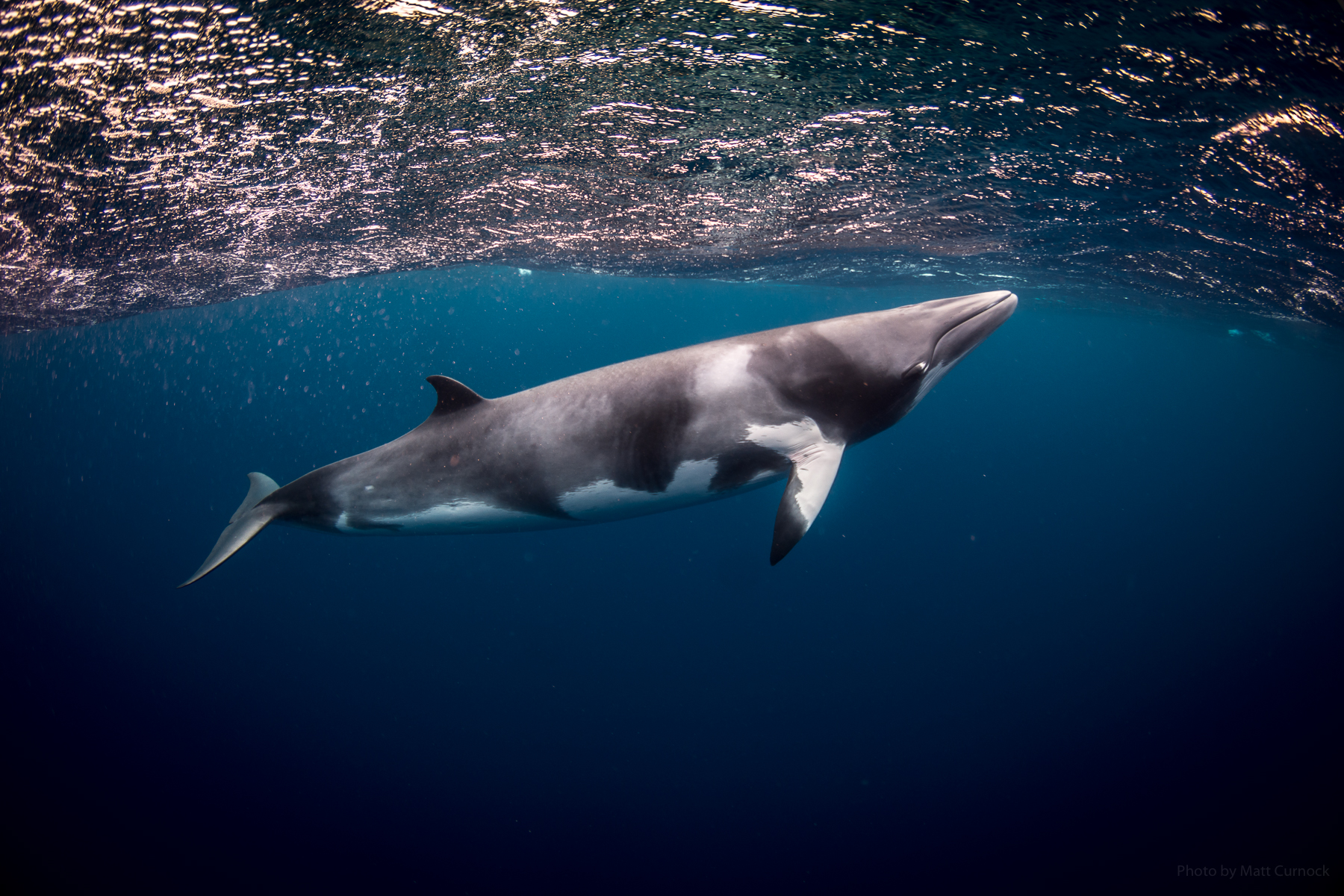
Every June and July, something extraordinary happens along a remote stretch of the Great Barrier Reef. Dwarf minke whales, the smallest of the baleen whales, arrive at the Ribbon Reefs near Lizard Island in one of the ocean’s most quietly spectacular seasonal events. And unlike just about anywhere else on the planet, here you can slip into the water and meet them.
Aroona Luxury Boat Charters is one of the most experienced private charter operations on the Great Barrier Reef, with skipper Ross bringing over 25 years of local knowledge to every voyage. From kite surfing and fly and sports fishing to island hopping, wreck hunting, snorkelling and diving, Aroona offers one of the most diverse ranges of reef experiences available anywhere in tropical north Queensland. But come June and July, one experience rises above all others. He’ll tell you that even after decades on the water, a minke encounter still stops you in your tracks.
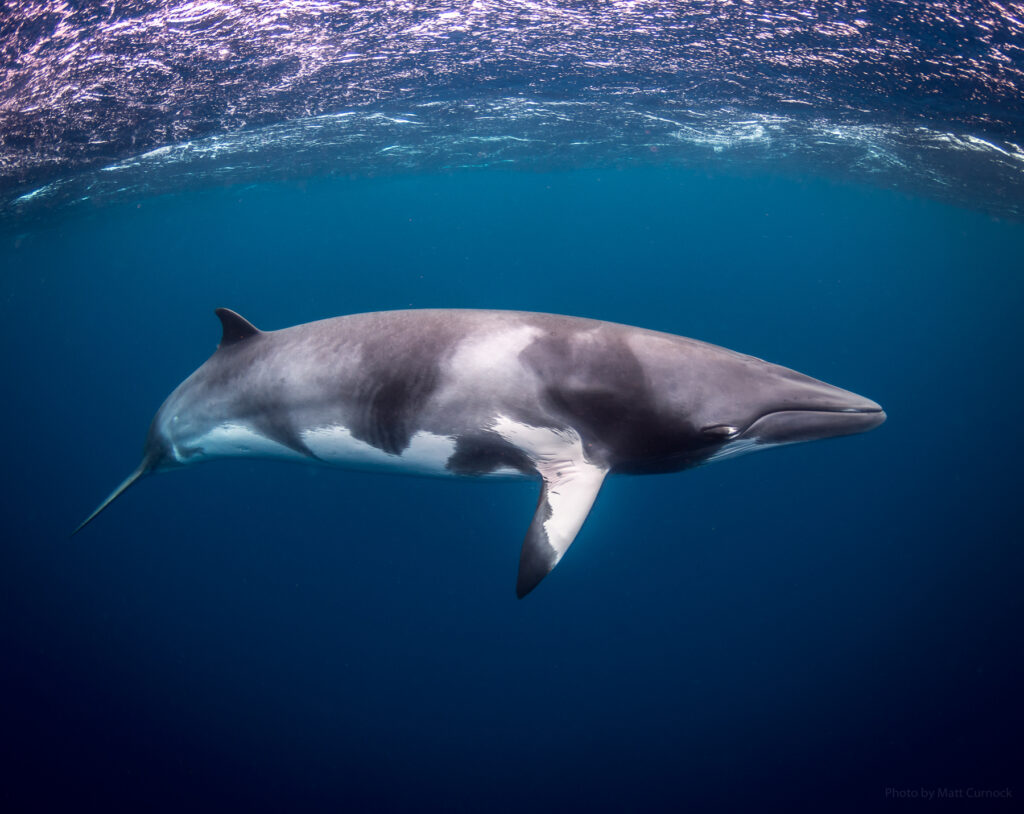
The northern Great Barrier Reef is the only known location where dwarf minke whales gather each year. Researchers believe the whales migrate from subantarctic waters north along Australia’s east coast, arriving between Port Douglas and Lizard Island from around May through to August, with June and July accounting for the overwhelming majority of sightings.
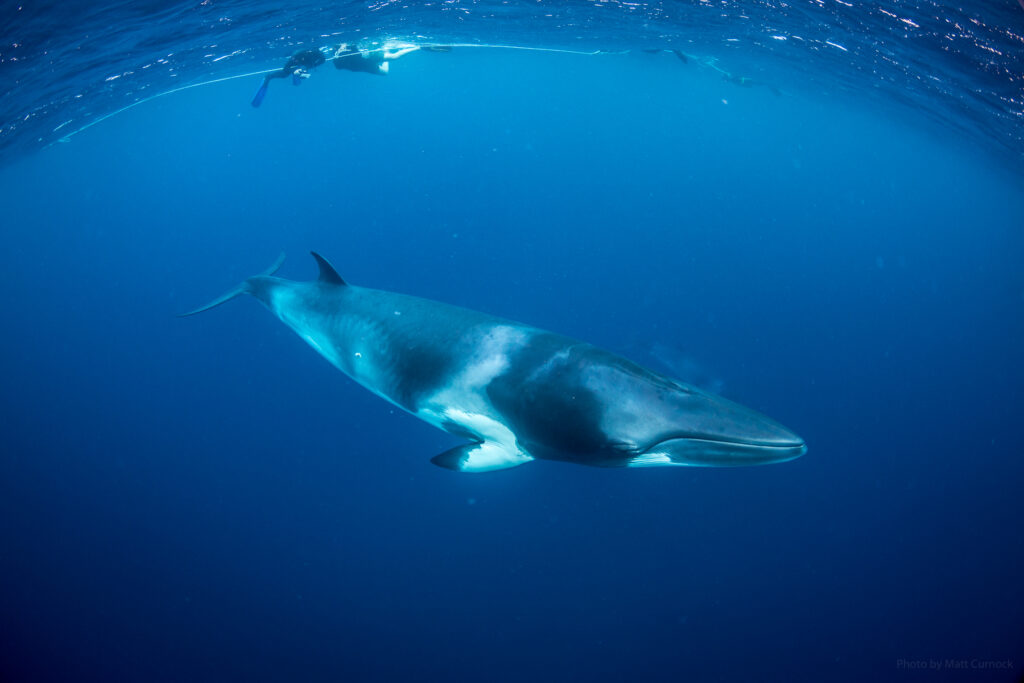
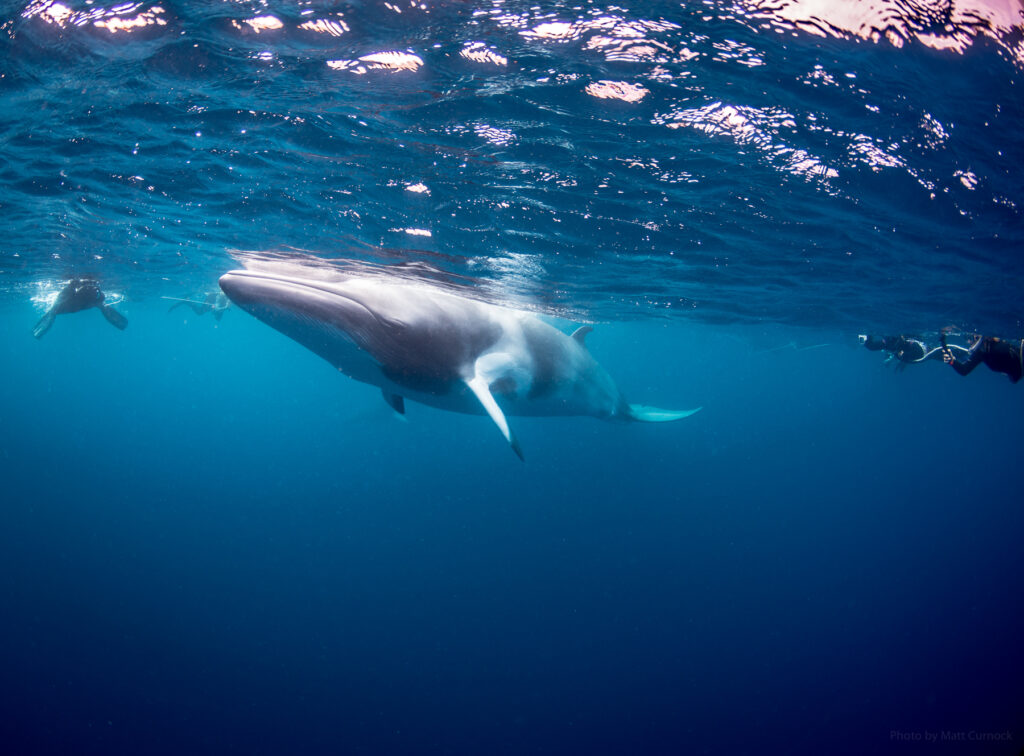
What makes this place truly singular is not just that the whales come, but that they come to you. Growing to around five to eight metres in length, dwarf minkes are notoriously inquisitive. They approach boats, snorkelers and divers closely, often circling for extended periods, making eye contact in a way that is, by all accounts, quietly life-changing.
Dr Matt Curnock, researcher with the Minke Whale Project and one of the world’s foremost authorities on these whales, has spent nearly two decades studying them in these exact waters. His advice to first-timers: “This will probably be the most emotionally rewarding encounter with a large animal underwater you will ever have in your life. The whales will come very close to check you out. Don’t panic. Keep calm and still and above all, enjoy how very special this amazing phenomenon is.”
He’s seen it hundreds of times, and it still gets him. When asked whether the experience ever became routine, Curnock said that even after fifteen years of research and in-water interactions, when a whale approaches closely and looks into your eyes, his heart is still thumping.
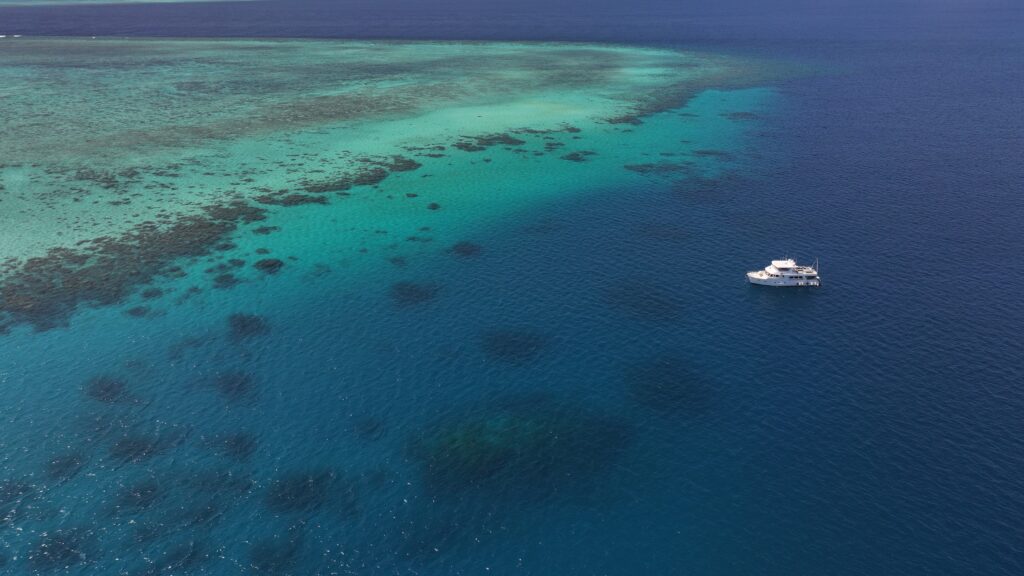
Aroona departs from Yorkeys Knob Marina, just 15 minutes north of Cairns Airport, and travels north along the Ribbon Reefs, one of the reef’s most celebrated diving and snorkelling corridors. The journey takes you through some of the clearest, most biodiverse waters on the reef before finishing at Lizard Island, from which guests take a scenic flight back to Cairns along the coastline.
Winter water temperatures along the Ribbon Reefs sit at around 20 degrees Celsius, cool enough to feel refreshing but warm by most standards. The conditions are typically calm, and the northbound passage itself is part of the draw, passing extraordinary reef formations and dive sites that Ross has been exploring across his 25-year career on the reef.
The charter is private, which means a very different atmosphere to the larger liveaboard vessels that run similar routes. You’re with a small group, on a boat that knows these waters intimately, in one of the most remarkable marine environments on earth.
The Aroona minke experience is run in collaboration with the Minke Whale Project, a long-standing research program based at James Cook University. During your time on the water, guests and crew collect observations and follow interaction guidelines that contribute directly to citizen science data, helping researchers better understand the behaviour, population dynamics and conservation needs of dwarf minke whales.
The project has been running field seasons in the Ribbon Reefs since 1996, making it one of the longest continuous cetacean studies in the Southern Hemisphere. In 2013, the research team achieved a world first by attaching satellite tracking tags to four minkes, following them as they journeyed thousands of kilometres south after leaving the reef. One young male, nicknamed Spot, was tracked all the way to the continental shelf off Sydney before his final signal was received deep in the subantarctic.
Dr Curnock, who was part of that tagging team, described the broader goal clearly: “A lot remains unknown about where they feed, where and when their calves are born, what risks and threats they face when outside the relative safety of Australian waters, as well as how their behaviour changes in response to interactions with vessels and divers.”
Your photographs can contribute too. Images taken during a minke encounter can be donated to the whale identification database, helping researchers track individual animals across seasons and years.
Tourism operators are required to hold an endorsement from the Great Barrier Reef Marine Park Authority to conduct swims with dwarf minkes. Aroona operates within that framework, meaning every interaction follows guidelines developed over decades of research to keep both whales and guests safe.
If you’re lucky enough to be in the water when a minke vocalises, you’ll understand immediately why researchers call it the “Star Wars sound.” The call is a metallic, electronic-sounding sequence, a blaster-like “da-da-da-daaaang” that is genuinely unlike any noise you’d expect to hear underwater from a living creature. Scientists were so startled when it was first recorded that some initially assumed it had to be coming from a vessel or equipment.
NOAA researcher Dr Jason Gedamke, who spent 92 hours recording dwarf minke vocalisations off the Australian coast, described the tones as so metallic he couldn’t believe they came from whales. The Star Wars sound has since become one of the acoustic signatures of the species, distinctive enough that researchers can use it to detect and track the whales’ movements across large areas of ocean.
Remarkably, no one is entirely sure how the whales produce it. They have no vocal cords in the conventional sense, yet the sound is loud, complex and highly structured. It’s one of many things that make the dwarf minke whale so compelling to scientists, and so unforgettable for anyone who encounters one.
Listen to the Dwarf Minke whale sound here: https://www.facebook.com/watch/?v=1578975549439265

The dwarf minke is the smallest baleen whale, and in many ways the least understood. While the North Atlantic and Antarctic minke whales are recognised as distinct species, the Great Barrier Reef population may represent yet another unnamed species, or a subspecies closely related to the North Atlantic form. The taxonomic question remains open.
What is known is that these animals are curious, social and remarkably predictable in their movements. They return to the same general area of the Ribbon Reefs year after year, visiting the same dive sites with something close to regularity. Researchers have been able to identify individual animals through photo-identification, building population records that now span almost three decades.
Population numbers, migratory routes outside Australian waters, feeding grounds and birthing locations all remain areas of active investigation. What the Minke Whale Project has demonstrated, though, is that swim-with-whale tourism, when managed carefully, can be a powerful driver of conservation research rather than a threat to it.
You can learn more about the whales and the research at minkewhaleproject.org.
Limited Availability for June and July
Spaces on Aroona’s minke whale charters are limited, and the season is short. If this is on your bucket list, the time to move is now.
Contact Ross: 0409 903 193 Email Carol: Carol@aroonalbc.com.au